Concrete driveways in Olathe, built for clay, frost and road salt
An Olathe driveway rarely fails in one day. It fails a little every freeze, at the garage where the salt drips off the car, and every wet spring when the clay under it swells. We build against all three from the base up.
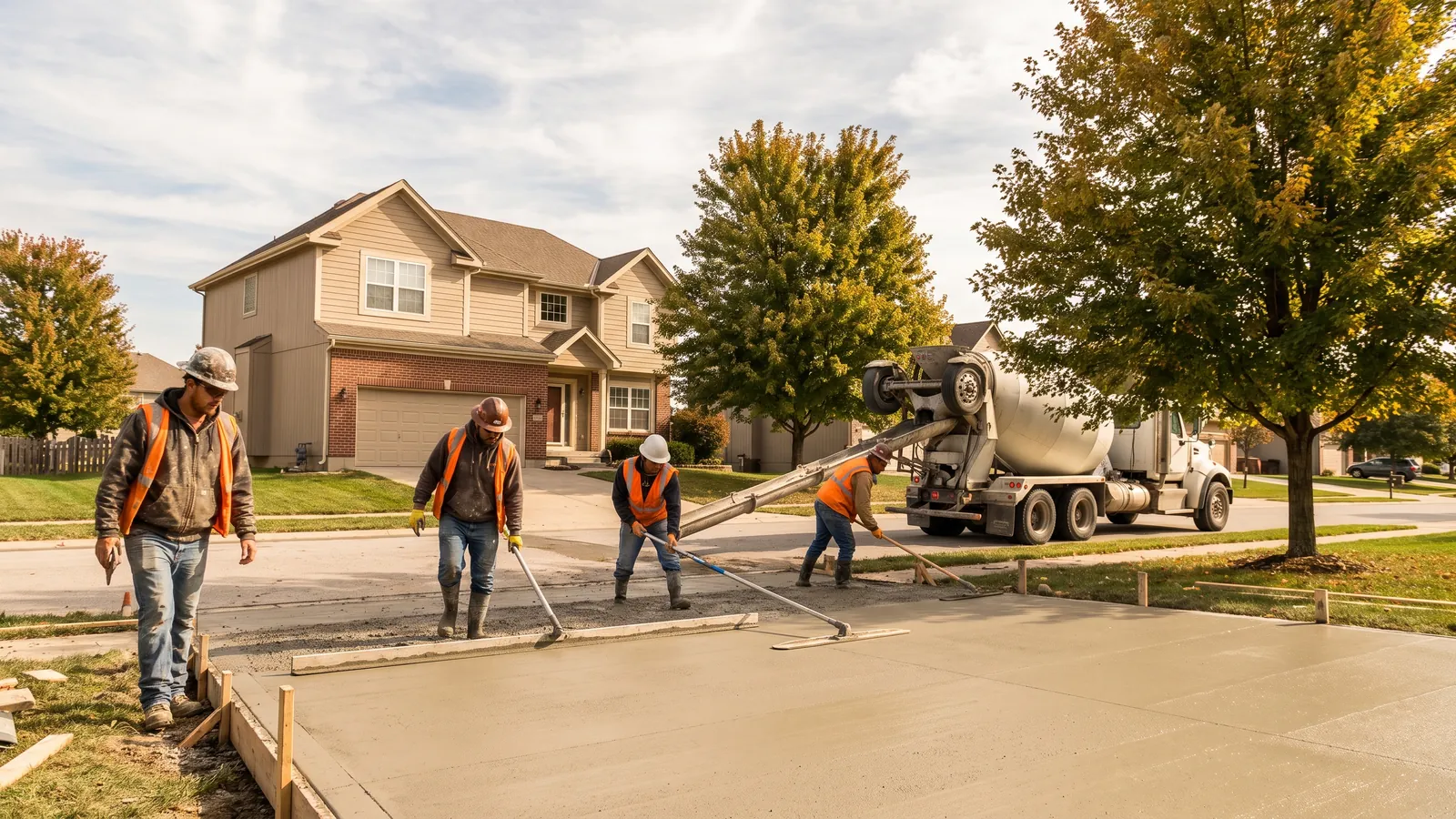
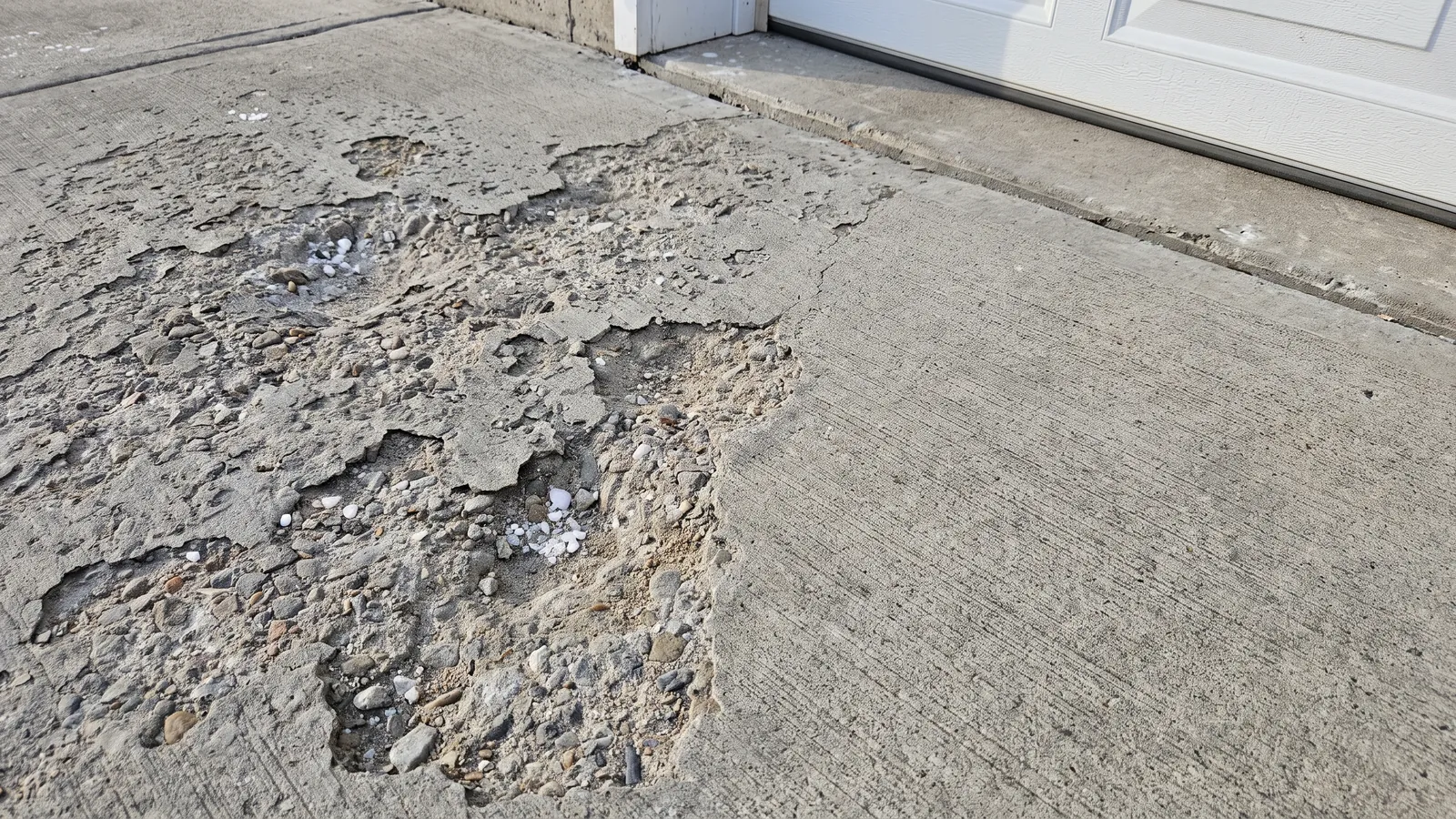
Most of the driveways we pour replace one that failed early, and in Olathe the cause is almost always some mix of three things. First, the ground: Johnson County's clay swells when it is wet and shrinks when it dries, and the Kansas Geological Survey says that seasonal heaving and shrinking cracks foundations, driveways and sidewalks across the state. A slab poured straight on it moves with it. Second, the winter: the Kansas City area freezes and thaws dozens of times between November and March, and water in the surface expands every time. Third, the salt: the deicer the road crews put down comes home on the car and drips off at the garage door and the approach, and chloride on concrete that was short on air or finished too early scales it in a winter or two.
A driveway that lasts here starts with the mix. We order around 4,000 psi with 6 to 7 percent entrained air, which is what the ready-mix industry specifies for exterior flatwork exposed to freezing and deicers, at a 3- to 5-inch slump so the surface isn't full of water. It sits on at least four inches of compacted base over the clay, graded so water runs away from the slab and the house rather than soaking in under the edge. Four inches of concrete for cars, five or six where a truck, a trailer or a camper parks, and steel where the ground or the load calls for it. Control joints go in the same day at about 10 to 12 feet, closer on a narrow drive, with isolation joints at the garage slab, the stoop and the approach so the pieces can move without pulling on each other. Then a curing compound on day one so it doesn't dry out in an August heat wave, and a breathable penetrating sealer in late summer once it has cured. We will tell you plainly: no chloride deicer of any kind on it the first winter, sand for traction, and never ammonium nitrate or ammonium sulfate ever.
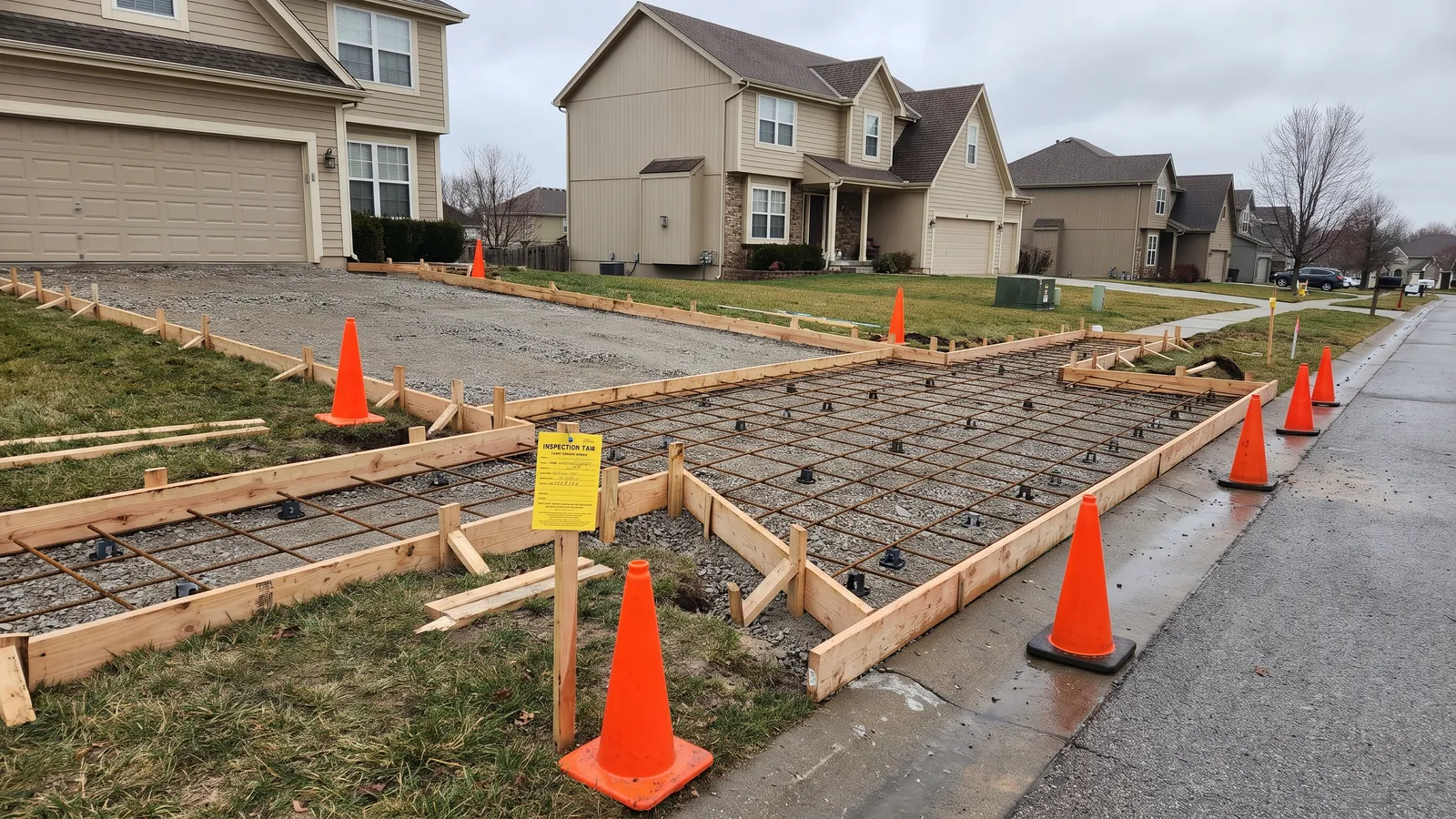
The driveway on your lot is yours; the approach between the sidewalk and the street is City of Olathe right-of-way. Work there needs the City's right-of-way permit ($50 per adjacent parcel), a pre-placement inspection requested 48 hours ahead, and concrete tickets emailed to the City within 24 hours of the pour; see approaches and sidewalks. The UDO also requires driveway entrances in the right-of-way to be concrete. If you have an HOA, its architectural committee probably wants to see a widening before we pour it, and we send the drawing.
What's included
Mixed for freeze-thaw and salt
6 to 7 percent entrained air and around 4,000 psi, ordered on the ticket and checked on the truck, not a bag mix or whatever is left on the plant.
A real base over the clay
At least four inches of compacted base, graded to drain, and more where we find soft, wet or disturbed clay.
Thickness for the load
Four inches for cars, five to six where a truck, trailer or camper parks, with rebar or wire on chairs where it is needed.
Joints where cracks belong
Saw-cut or tooled the same day at roughly 10 to 12 feet, with isolation joints at the garage slab, the stoop and the approach.
Drainage first
Graded away from the foundation and off the slab, downspouts extended past the edge, sprinkler heads moved back.
Cured and sealed
A curing compound on day one, a breathable silane or siloxane sealer in late summer, and written first-winter care.
Concrete driveways cost in Olathe, KS
| Job | Typical price | Notes |
|---|---|---|
| Standard broom-finish driveway, reinforced | $8 – $12 per sq ft | Two-car 24×40 ≈ $7,700–$11,500 |
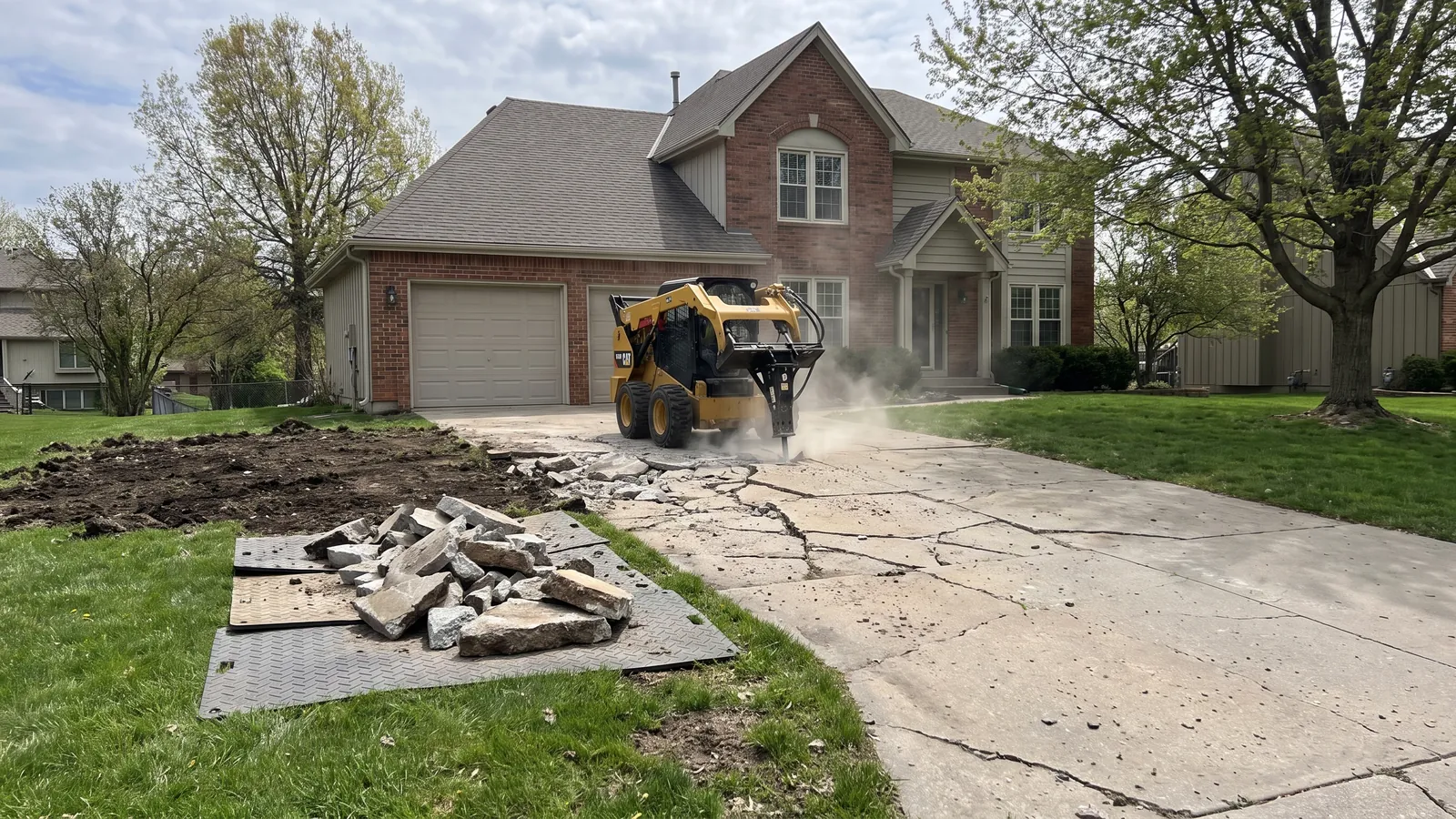
| Break-out and haul of the old driveway | $1.50 – $2.50 per sq ft | Concrete goes to a recycler where accepted |
| Widening or an extra parking strip | $9 – $13 per sq ft | Small pours cost more per foot |
| Five- or six-inch section for a truck, trailer or camper | + $1.50 – $2.50 per sq ft | See RV slabs |
| Extra base where the clay is soft or wet | + $1 – $2 per sq ft | Found when we probe, priced before you sign |
| Penetrating sealer after cure | $0.90 – $1.60 per sq ft | Recommended before the first winter |
| Approach in the City right-of-way | Priced separately | City permit and inspection; see approaches |
These are 2026 Johnson County ranges to help you budget. Your written price is itemized (removal, base, mix, thickness, reinforcement, finish, joints, sealer and any permit) and good for 30 days.
Recent work
Questions we get about concrete driveways
How thick should a driveway be in Olathe?
Four inches for cars, five to six where a truck, trailer or camper parks, on at least four inches of compacted base. The base matters more here than in most places because the clay underneath moves; a slab on a drained, compacted base moves a lot less.
Why does the concrete need air in it?
Entrained air puts billions of tiny bubbles in the paste, and freezing water has room to expand into them instead of breaking the surface. With dozens of freeze-thaw cycles a winter here and salt on top, a mix without enough air scales. The industry target for exterior slabs exposed to deicers is 6 to 7 percent.
Can I use ice melt on new concrete?
Not in its first winter, and never ammonium nitrate or ammonium sulfate, which attack concrete chemically. Use sand for traction that first year. After that, a little plain rock salt on a sealed, air-entrained slab is the least harmful choice, and hose the residue off when you can. We leave written care instructions.
Do I need a permit for a new driveway?
Not for the slab on your lot in most cases. Yes, from the City, for anything in the right-of-way: the approach, a curb cut or the public sidewalk. Your HOA may want to approve a widening. We sort that out at the estimate.
When can I drive on it?
Walk on it the next day and drive cars on it after about seven days. Heavy trucks and campers should wait two to four weeks. In cold weather it takes longer, and we tell you the date.
What time of year is best?
April through October is easiest. We pour in the shoulder seasons with blankets and a heated mix, keep the concrete above 50 degrees while it sets, and move a pour date when a hard freeze is in the forecast. In July we start at first light.