The ground under Olathe: why clay cracks concrete and what to do about it
A slab in Olathe sits on clay that swells every wet spring and shrinks every dry August. Most of the cracked, heaved and sunken concrete we see is the ground moving, not the concrete failing. Here is what the clay does and how a slab is built to live with it.
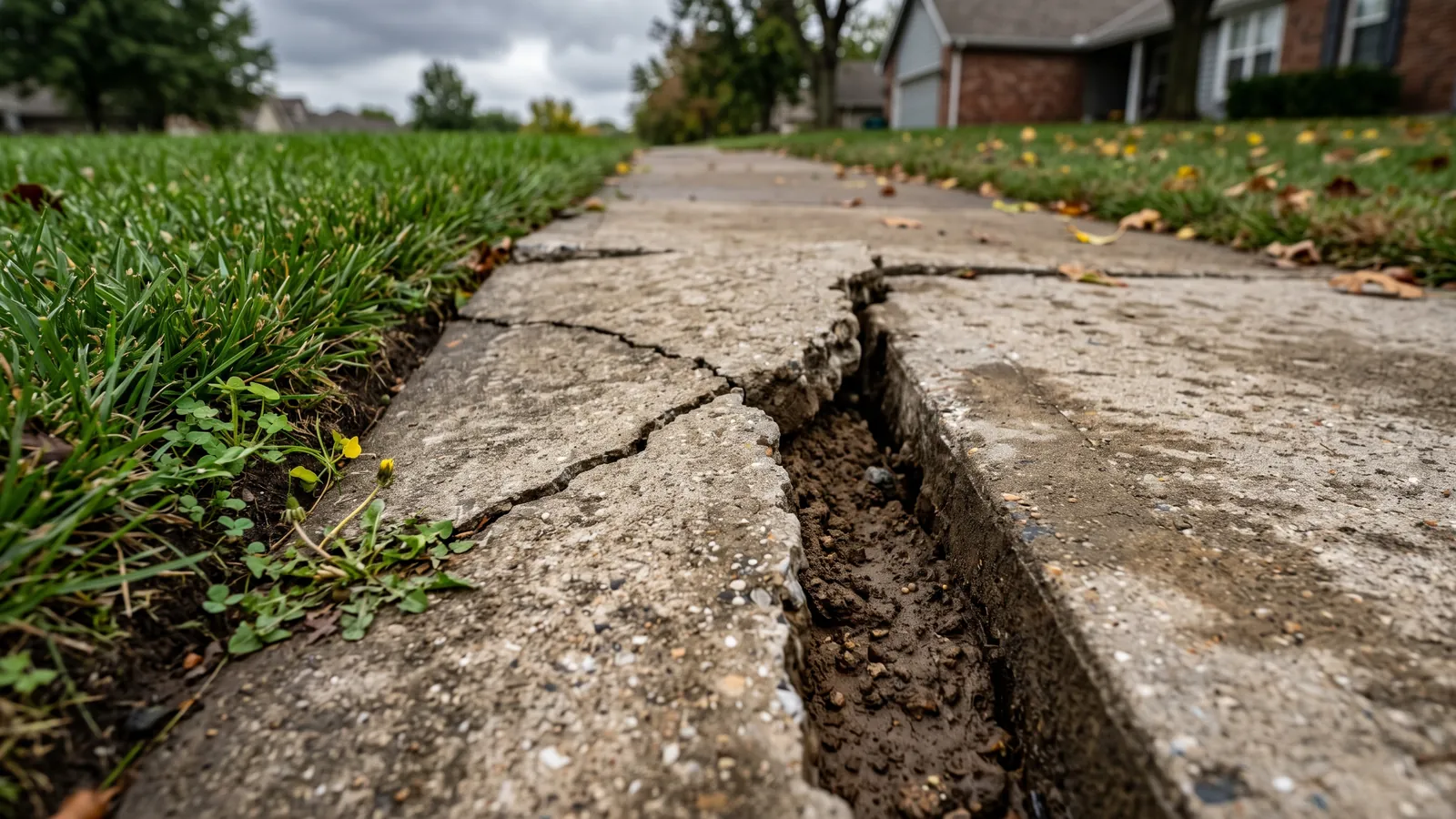
What expansive clay does
The soils under Johnson County are mostly clays weathered from the limestone and shale underneath, and clay changes volume with its moisture. The Kansas Geological Survey puts it plainly: expansive soils are a more pervasive problem in Kansas than landslides. Where clay deposits underlie the surface, trapped water makes the clay and the soils derived from it swell, then shrink during dry periods, and that seasonal heaving and shrinking cracks foundations, driveways and sidewalks. Nobody has estimated the damage statewide, but every concrete contractor in the county could point to it on any street.
A slab on clay moves in three ways. It heaves when the clay under it gets wet and swells, usually at a corner where a downspout dumps or a sprinkler head soaks, lifting one panel against the next. It settles when the clay dries and shrinks, or when loose backfill compacts, leaving a void under the slab and a panel that tips into it. And it cracks when one part of the slab is held up and another isn't, which is what happens when half of it sits on undisturbed ground and half on a trench or a filled low spot.
Where it shows up
- The garage apron. The overdig around the foundation was backfilled loosely and keeps settling, and the roof drains to it. The first panel drops and the slab breaks at the garage.
- The front stoop. Same backfill, plus frost. It settles away from the house in summer and lifts into the door in winter.
- Sidewalk and walkway panels. Poured straight on the clay with no base, they tip at the joints as the ground moves and become trip hazards.
- Patios by the back door. The downspout dumps at the edge, the clay swells, the slab heaves and cracks toward the house.
- The driveway in a dry August. The clay shrinks away from the slab, the slab is unsupported, and the next car finds the crack.
How a slab is built to live on clay
A compacted, drained base. Four inches or more of compacted base between the slab and the clay spreads the load, drains water away from the clay instead of into it, and gives the slab something that doesn't swell to sit on. Soft, wet or disturbed clay is dug out first and replaced with base compacted in lifts. Water kept away. Downspouts extended past the slab, grade sloped away from the house and the slab, sprinkler heads moved back from the edge, and the slab itself sloped so nothing pools. Joints. Control joints at 10 to 12 feet on a driveway, 5 feet on a walk, so the slab cracks in straight lines where it was told to; isolation joints at the house, the garage slab, the stoop and the approach so each piece moves on its own. Reinforcement. Rebar or wire on chairs where the ground is doubtful or the load is heavy, so a crack that does form stays tight. Footings for anything that carries a building. Below the frost line, through the active clay, so the structure doesn't ride the seasons.
What to do about a slab that's already moving
Fix the water first: the downspout, the sprinkler, the grade. Then, if the concrete is sound and has settled, lift it. If it has heaved, the cause has to be removed and the panel often replaced on a proper base. If it's cracked into pieces, replace it. A crack that has stopped moving can be sealed so water stops getting through it to the clay. See repair.
Common questions
Is the clay a problem for a new driveway?
Only if the driveway is poured straight on it. On a compacted, drained base, with joints at the right spacing and water kept off the edges, the clay moves and the slab mostly doesn't.
Why did my sidewalk heave two inches at one joint?
Wet clay under one panel swelled and lifted it, usually fed by a downspout, a sprinkler or a low spot. The fix is the water, then the panel.
Can you tell what's under my yard?
We probe the base and the clay where it matters, and we dig a test hole where a building slab or a big pad is going. What we find goes on the estimate before you sign.
Does rebar stop cracks?
It doesn't stop them; it holds them tight so they don't open or offset. The base and the joints are what reduce cracking.
Should I water my foundation in a drought?
Keeping the clay around a foundation evenly moist is a common recommendation in this area for foundations; for a driveway or patio, keeping water off the edges matters more than keeping it on.
Related: Mudjacking and polyjacking · Concrete repair · Concrete patios · Salt and scaling