Why Olathe concrete scales, and how to stop it
The top eighth of an inch flakes off at the garage door and the approach, usually within a few winters. It isn't bad luck. It's water, salt, freezing and a mix or a finish that couldn't take them. Here is how it happens and how to prevent it.
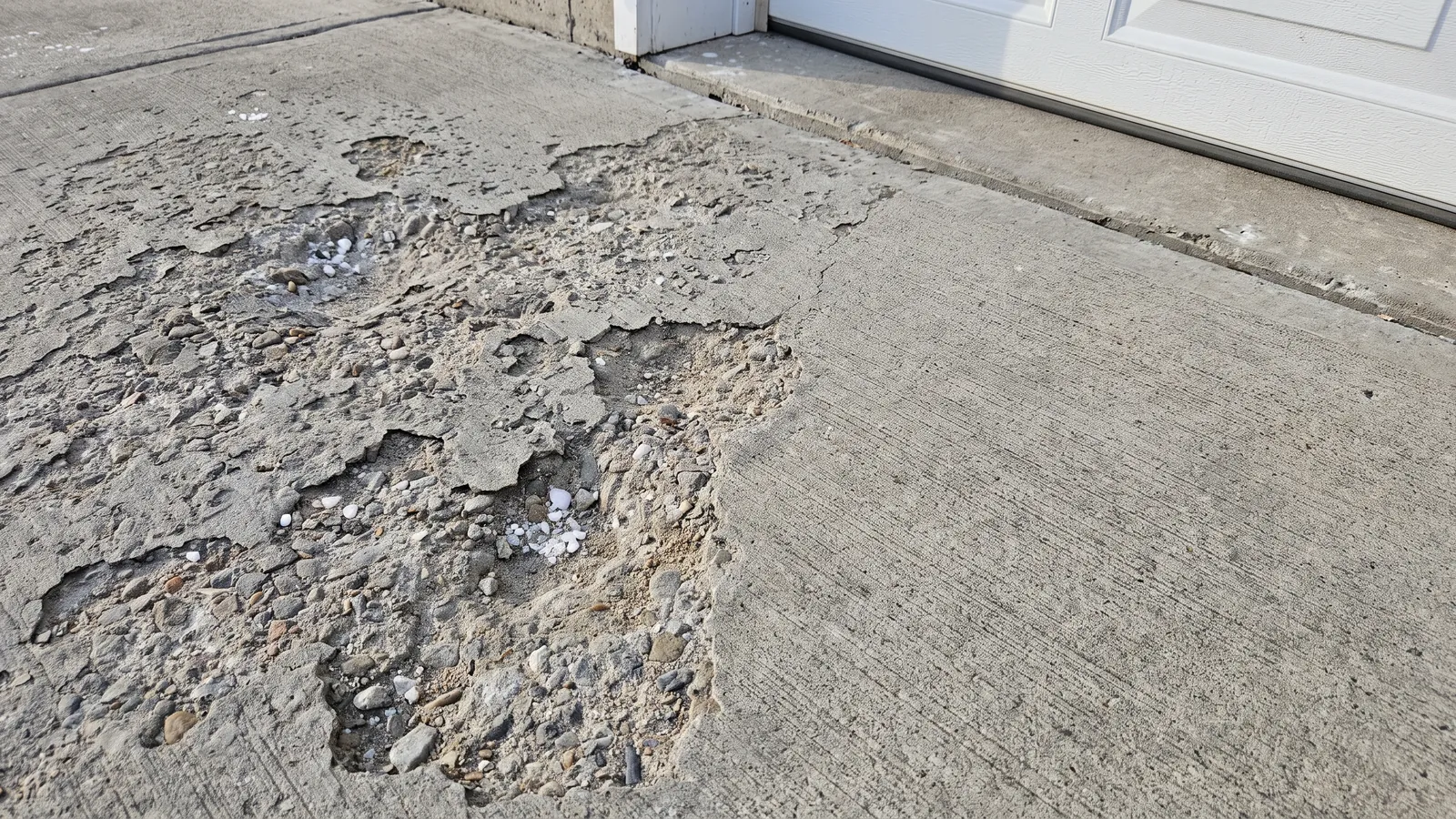
What scaling is
Scaling is the surface of a slab flaking away in patches, leaving the paste gone and the sand or small stone showing. It starts at the places that get the wettest and the saltiest: the first panel of the driveway where the car drips, the approach at the street, the walk and the stoop where the ice melt goes. Once it starts it spreads, because the rough surface holds more water than the smooth one did.
How it happens here
Concrete is porous. Water soaks into the top layer, and when it freezes it expands about nine percent. In a mix with enough entrained air, that expanding water has billions of tiny bubbles to push into and nothing breaks. In a mix without enough air, or with a weak surface layer, the pressure breaks the paste a little every freeze. Kansas City winters freeze and thaw dozens of times between November and March, and each cycle does a little more.
Salt makes it worse in three ways. It keeps the surface wet below freezing, so there is more water in the pores when the cold comes; it draws moisture into the concrete; and it adds freeze-thaw cycles by melting ice that then refreezes. The ready-mix industry's own guidance on scaling says it: calcium and sodium chloride applied heavily to weak, poorly air-entrained or poorly cured concrete cause scaling. And two products attack concrete outright: ammonium sulfate and ammonium nitrate, which are sold as deicers and fertilizers, should never go on it.
The third cause is the original pour. A surface finished while bleed water was still on top has a weak, watery top layer that scales almost on its own. A surface overworked with a steel trowel outdoors has the air driven out of its top skin. A slab that was never cured dried from the top and never gained strength there. Most of the scaled driveways we see in Olathe had two of these three going against them before the first bag of salt was opened.
What prevents it
- Air. 6 to 7 percent entrained air for severe exposure with deicers (4 to 6 percent for moderate exposure without them), ordered on the ticket.
- Strength and slump. About 4,000 psi where deicers are used, 3,500 for plain freeze-thaw, placed at a 3- to 5-inch slump so the surface isn't full of water.
- Finishing. No finishing while bleed water is on the surface; bull float right after screeding; no steel trowel on an exterior slab; a broom finish for grip.
- Curing. A curing compound or wet burlap right after finishing, and the concrete kept at or above 50°F while it sets in cold weather.
- The first winter. No calcium or sodium chloride on new concrete its first year. Sand for traction. After that, salt sparingly and hose the residue off.
- Sealing. A breathable silane or siloxane sealer applied in late summer, when the slab is dry and warm, so it goes into winter protected. Not a glossy film that traps water and gets slick.
- Drainage. No standing salt water on the slab: slope it, extend the downspouts, move the sprinkler heads.
What to do with a slab that's already scaling
If it's a few patches on a sound slab, clean it, seal it, keep the salt off and live with it. If the surface has gone over most of the slab but the concrete underneath is sound and flat, a bonded overlay gives a new surface for $4 to $8 per square foot. If it's scaled to the stone and cracked, it's a replacement, and this time the mix, the finish and the first winter will be right. See repair and resurfacing.
Common questions
Which deicer is safe on concrete?
On concrete over a year old, air-entrained and sealed: plain rock salt (sodium chloride), used sparingly and hosed off. Calcium chloride is similar. Never ammonium nitrate or ammonium sulfate. On concrete in its first winter: none; use sand.
Is scaling covered by a warranty?
Builder warranties on concrete are short and usually exclude surface wear and deicer damage. Homeowners insurance doesn't cover it. That's why we put the mix and the first-winter care in writing.
When should I seal?
Late summer, when the slab is dry and warm. New concrete once it's cured; older concrete every three to five years with a penetrating sealer, two to three with a decorative one.
Can scaling be stopped once it starts?
Slowed, yes: clean, seal, keep salt off, fix the drainage. The flaked patches don't heal, so the choice is to live with them, overlay the slab or replace it.
Does a sealer make it slippery?
A penetrating sealer doesn't. A film sealer can, which is why we don't put one on a driveway.
Related: Sealing · Concrete repair · Driveway replacement · Clay and cracks